Answers From Me
ROLE: Product Designer
TOOLS: Figma
DURATION: 4 months
Answers From Me
ROLE: UI/UX Designer
TOOLS: Figma
DURATION: 4 months
Answers From Me
ROLE: UI/UX Designer
TOOLS: Figma
DURATION: 4 months
OVERVIEW
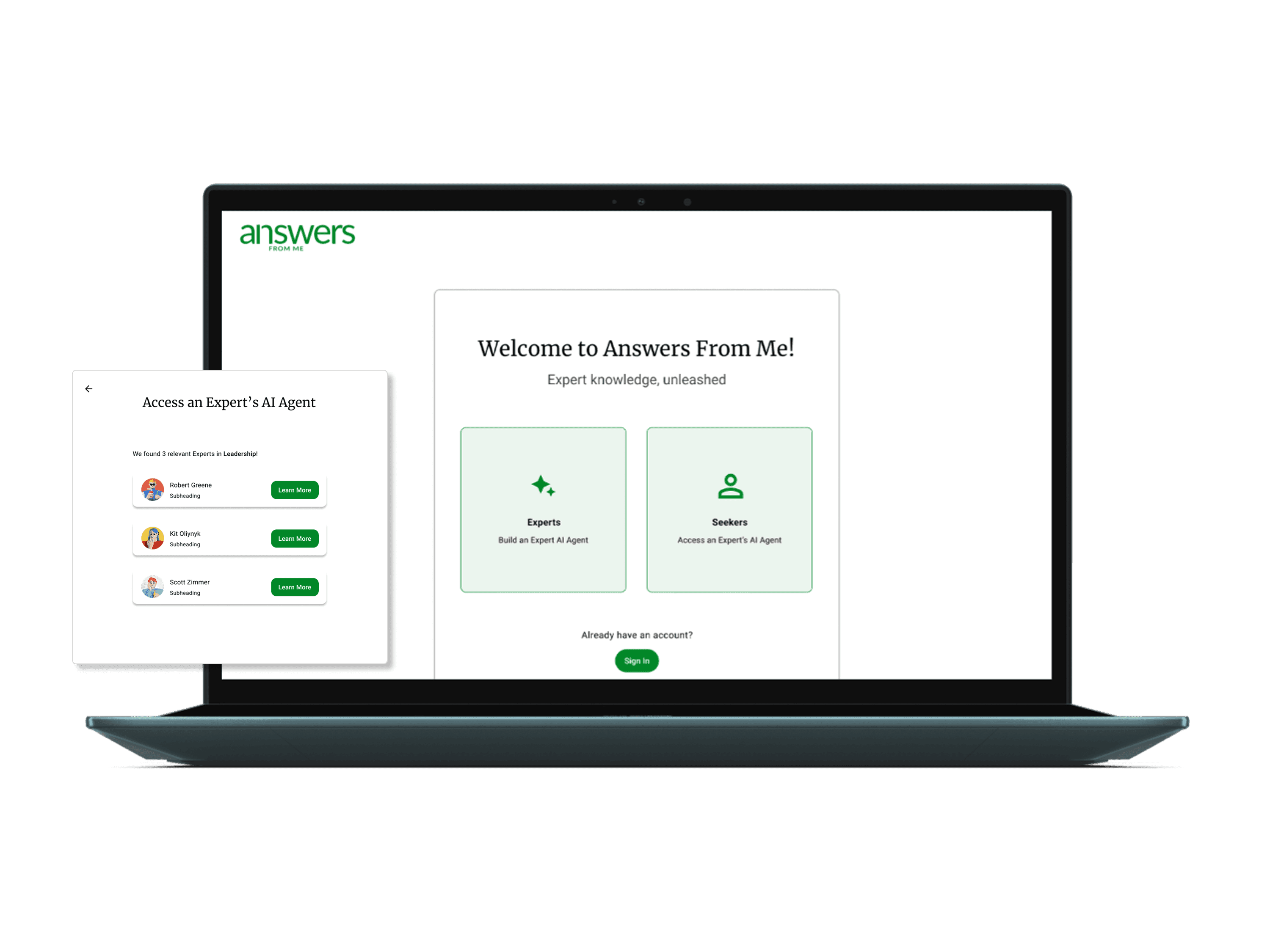
Answers From Me is a generative AI startup that connects Experts with Seekers through AI-powered Knowledge Agents. As a summer design intern, I redesigned the Seeker onboarding experience to address a critical problem: high drop-off rates during the onboarding process. My work focused on reducing friction, demonstrating value earlier, and driving activation. I also contributed to the expert page and marketing website redesigns.
OVERVIEW
Answers From Me is a generative AI startup that connects Experts with Seekers through AI-powered Knowledge Agents. As a summer design intern, I redesigned the Seeker onboarding experience to address a critical problem: high drop-off rates during the onboarding process. My work focused on reducing friction, demonstrating value earlier, and driving activation. I also contributed to the expert page and marketing website redesigns.
OVERVIEW
Answers From Me is a generative AI startup that connects Experts with Seekers through AI-powered Knowledge Agents. As a summer design intern, I redesigned the Seeker onboarding experience to address a critical problem: high drop-off rates during the onboarding process. My work focused on reducing friction, demonstrating value earlier, and driving activation. I also contributed to the expert page and marketing website redesigns.
CONTEXT
CONTEXT
How does Answers From Me work?
How does Answers From Me work?
Answers From Me (previously known as Tmpt.me) is a generative AI startup that helps Experts turn their knowledge into AI-powered agents. Using Retrieval-Augmented Generation (RAG), the platform transforms uploaded content into interactive Knowledge Agents that can answer questions and provide tailored guidance 24/7. Answers From Me serves two distinct user groups: Experts who create Knowledge Agents, and Seekers who can access them by joining an Expert's "hub" through a direct invite link or through the marketing website. During this internship, my main focus was on the Seeker experience.
Answers From Me (previously known as Tmpt.me) is a generative AI startup that helps Experts turn their knowledge into AI-powered agents. Using Retrieval-Augmented Generation (RAG), the platform transforms uploaded content into interactive Knowledge Agents that can answer questions and provide tailored guidance 24/7. Answers From Me serves two distinct user groups: Experts who create Knowledge Agents, and Seekers who can access them by joining an Expert's "hub" through a direct invite link or through the marketing website. During this internship, my main focus was on the Seeker experience.
THE CHALLENGE
THE CHALLENGE
Increasing User Activation
Increasing User Activation
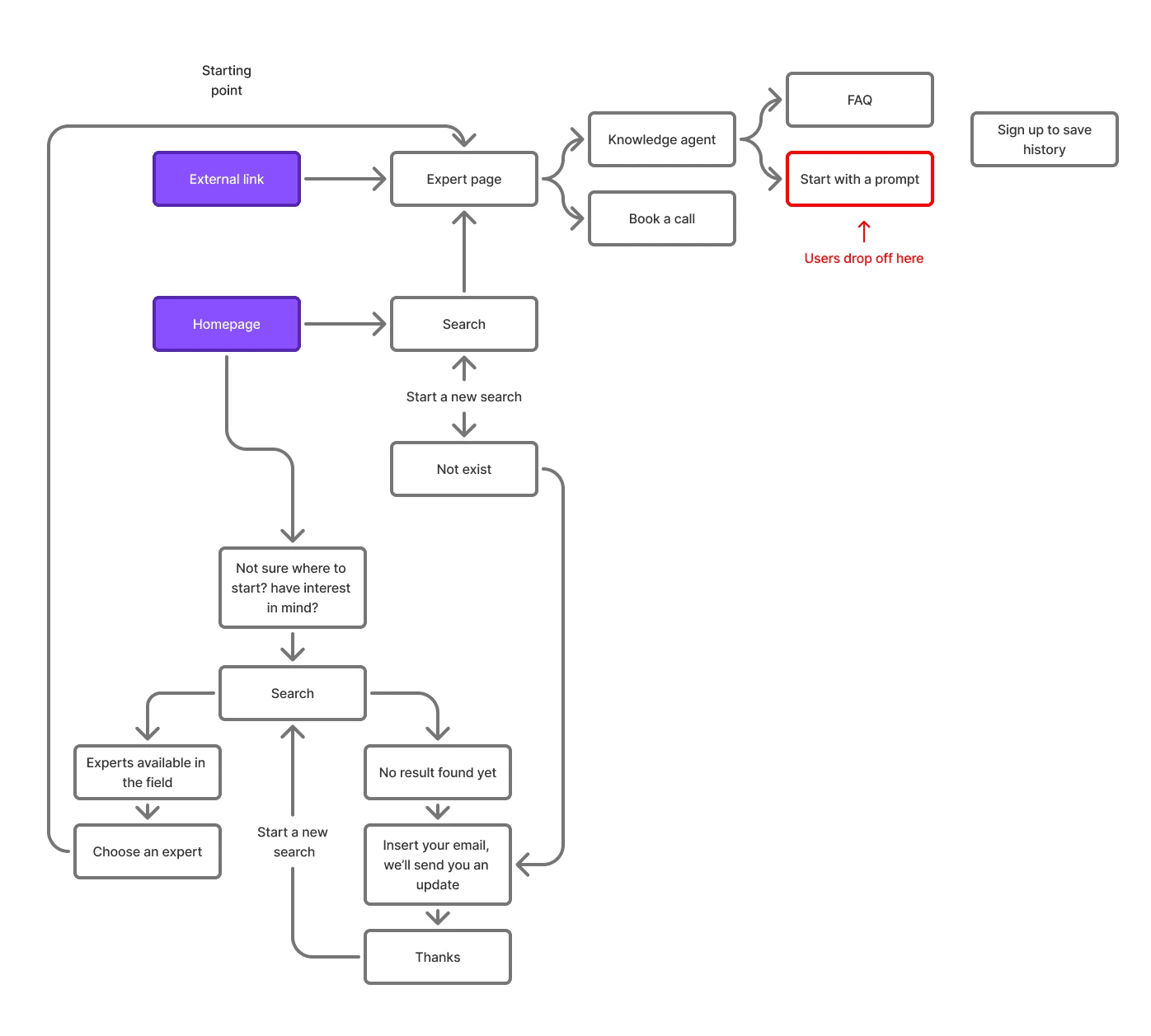
Scott Zimmer, CEO of Answers From Me, shared that a major problem with the platform was that both Seekers and Experts would abandon it after their first experience. The user journey map from the team, shown below, revealed that Seekers dropped off specifically during the sign-up process — whether they arrived from the marketing site's home page or through a direct link to the app from their expert. Many didn't know how to begin or what to ask the Knowledge Agent, leading to hesitation and disengagement. This pointed to a critical need, which shaped my central design question: How might we reimagine the onboarding flow to reduce friction and increase activation?
Scott Zimmer, CEO of Answers From Me, shared that a major problem with the platform was that both Seekers and Experts would abandon it after their first experience. The user journey map from the team, shown below, revealed that Seekers dropped off specifically during the sign-up process — whether they arrived from the marketing site's home page or through a direct link to the app from their expert. Many didn't know how to begin or what to ask the Knowledge Agent, leading to hesitation and disengagement. This pointed to a critical need, which shaped my central design question: How might we reimagine the onboarding flow to reduce friction and increase activation?
User Journey Map
User Journey Map
RESEARCH
RESEARCH
Analyzing the Current Flow
Analyzing the Current Flow
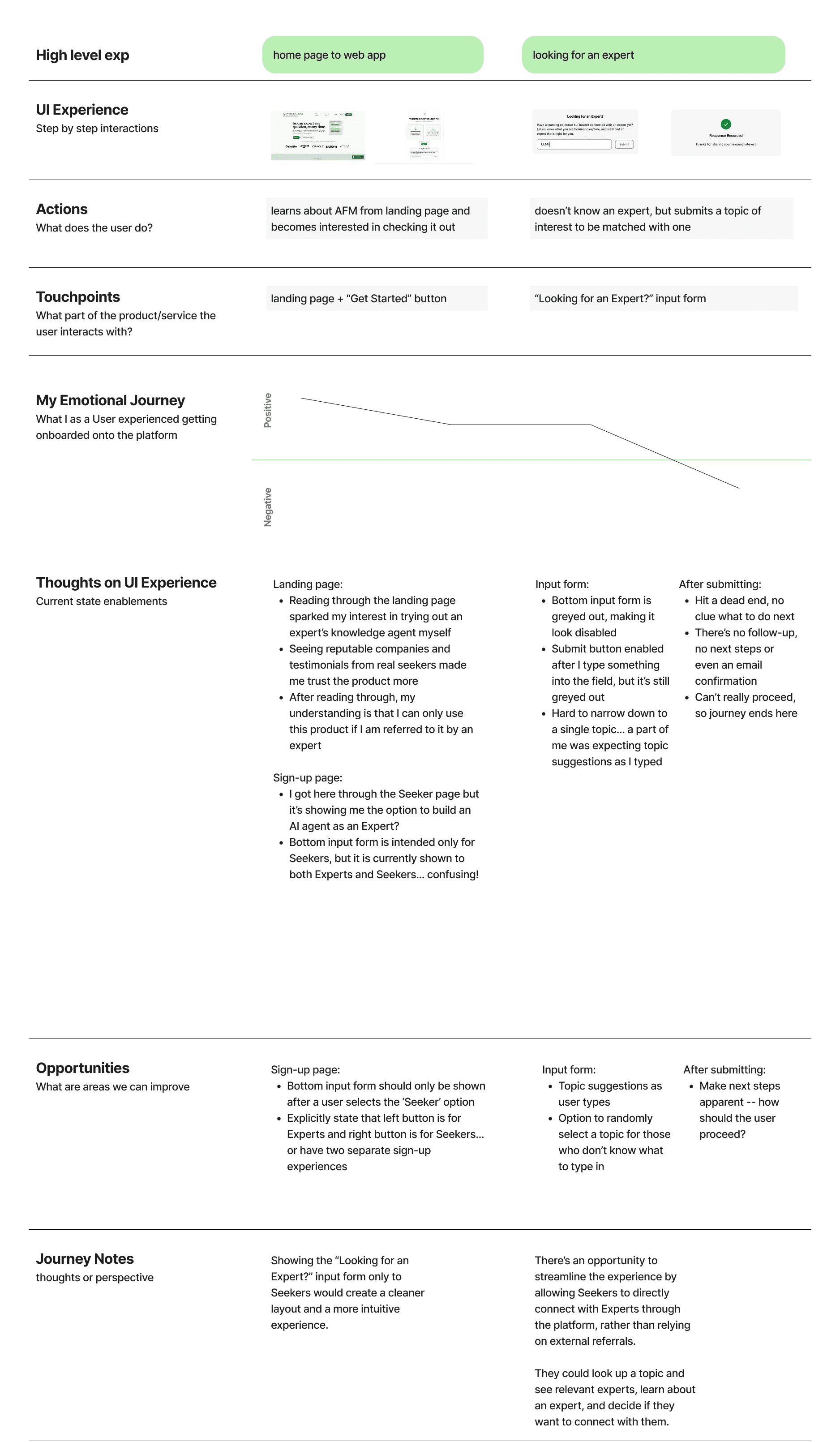
To identify potential pain points and opportunities for improvement, I created two experience maps: one for the journey of a Seeker who is trying to find an expert to connect with, and one for the journey of a Seeker who already has an expert in mind.
To identify potential pain points and opportunities for improvement, I created two experience maps: one for the journey of a Seeker who is trying to find an expert to connect with, and one for the journey of a Seeker who already has an expert in mind.
Experience Map 1: User who is looking for an Expert
Experience Map 1: User who is looking for an Expert
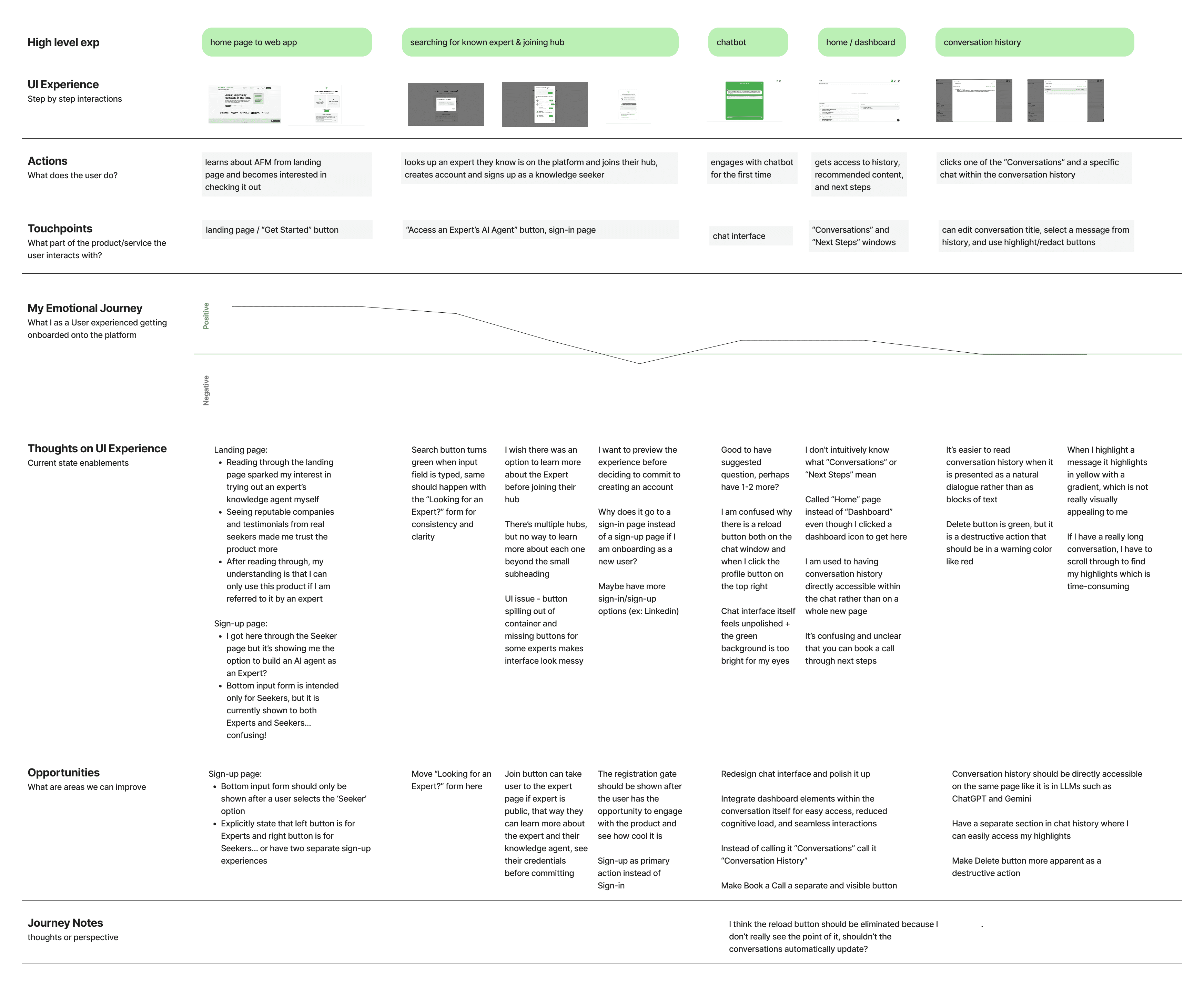
Experience Map 2: User who already has an Expert in mind
Experience Map 2: User who already has an Expert in mind
My biggest pain points:
My biggest pain points:
In the "Looking for an Expert" flow, my journey abruptly hit a dead end after I submitted a topic. There was no confirmation or follow-up, and no way to proceed after I submitted my topic of interest to be matched with an expert.
In the "Looking for an Expert" flow, my journey abruptly hit a dead end after I submitted a topic. There was no confirmation or follow-up, and no way to proceed after I submitted my topic of interest to be matched with an expert.
In the "Having an Expert in mind" flow, I was hit with a registration gate immediately upon trying to join an Expert's hub. I had no ability to engage with the product or even preview the expert's page before deciding to commit.
In the "Having an Expert in mind" flow, I was hit with a registration gate immediately upon trying to join an Expert's hub. I had no ability to engage with the product or even preview the expert's page before deciding to commit.
After signing up, I was directly taken to the expert's chatbot, which was on its own page. There was a disconnect with the dashboard being on a separate page, and I expected a side-panel of conversation history accessible directly within the chat interface.
After signing up, I was directly taken to the expert's chatbot, which was on its own page. There was a disconnect with the dashboard being on a separate page, and I expected a side-panel of conversation history accessible directly within the chat interface.
Hearing from Users
Hearing from Users
After going through the onboarding experience myself, I was curious if other Seekers shared the same frictions as me. I created a project plan that I shared with the team which included user interviews, and I wrote up an interview guide. I prioritized recruiting users who had dropped off after first use, however, this was a major challenge as we only had contact info for four users, and despite our best efforts, response rates were extremely low.
After going through the onboarding experience myself, I was curious if other Seekers shared the same frictions as me. I created a project plan that I shared with the team which included user interviews, and I wrote up an interview guide. I prioritized recruiting users who had dropped off after first use, however, this was a major challenge as we only had contact info for four users, and despite our best efforts, response rates were extremely low.
Thus, I took a multi-angle approach. I conducted one in-depth interview with a real Seeker and combined those insights with interview data from fellow UXR interns. I also utilized a survey distributed through personal networks, gathering 11 responses to spot broader trends. I identified the following key insights and translated them into design implications.
Thus, I took a multi-angle approach. I conducted one in-depth interview with a real Seeker and combined those insights with interview data from fellow UXR interns. I also utilized a survey distributed through personal networks, gathering 11 responses to spot broader trends. I identified the following key insights and translated them into design implications.
Insight #1: Seekers who receive a direct expert link already understand what the Knowledge Agent is and what it can do because their Expert briefed them beforehand. This means they don't need to look up an expert, instead, they want a fast, frictionless path to immediately join the hub and start asking questions.
Design implication: For users arriving via expert links, skip expert search and get them to the chat faster, reducing time to value and increasing potential conversion.
Insight #1: Seekers who receive a direct expert link already understand what the Knowledge Agent is and what it can do because their Expert briefed them beforehand. This means they don't need to look up an expert, instead, they want a fast, frictionless path to immediately join the hub and start asking questions.
Design implication: For users arriving via expert links, skip expert search and get them to the chat faster, reducing time to value and increasing potential conversion.
Insight #2: Many Seekers are already familiar with ChatGPT and other LLMs, which provide easy access to conversation history via a side panel. This is an established mental model.
Insight #2: Many Seekers are already familiar with ChatGPT and other LLMs, which provide easy access to conversation history via a side panel. This is an established mental model.
Design implication: Integrating conversation history directly into the chat interface (rather than hiding it in a separate page) reduces cognitive load and builds on users' existing expectations, making the experience feel more intuitive and trustworthy.
Design implication: Integrating conversation history directly into the chat interface (rather than hiding it in a separate page) reduces cognitive load and builds on users' existing expectations, making the experience feel more intuitive and trustworthy.
Insight #3: Users are more engaged when they can chat with the Knowledge Agent directly on the Expert Page, rather than having to click into a separate interface.
Insight #3: Users are more engaged when they can chat with the Knowledge Agent directly on the Expert Page, rather than having to click into a separate interface.
Design implication: Every additional click creates an opportunity for drop-off. Integrating chat functionality where users already are (the Expert Page) removes friction and maintains momentum, increasing the likelihood users will start a conversation.
Design implication: Every additional click creates an opportunity for drop-off. Integrating chat functionality where users already are (the Expert Page) removes friction and maintains momentum, increasing the likelihood users will start a conversation.
Insight #4: Not all Seekers arrive with an expert in mind. Without clear pathways to discover relevant experts, these users feel lost during onboarding and are more likely to abandon the platform.
Insight #4: Not all Seekers arrive with an expert in mind. Without clear pathways to discover relevant experts, these users feel lost during onboarding and are more likely to abandon the platform.
Design implication: Providing topic-based or name-based expert discovery during onboarding helps undirected Seekers discover value quickly, turning uncertainty into engagement and reducing drop-off.
Design implication: Providing topic-based or name-based expert discovery during onboarding helps undirected Seekers discover value quickly, turning uncertainty into engagement and reducing drop-off.
IDEATION
User Flow
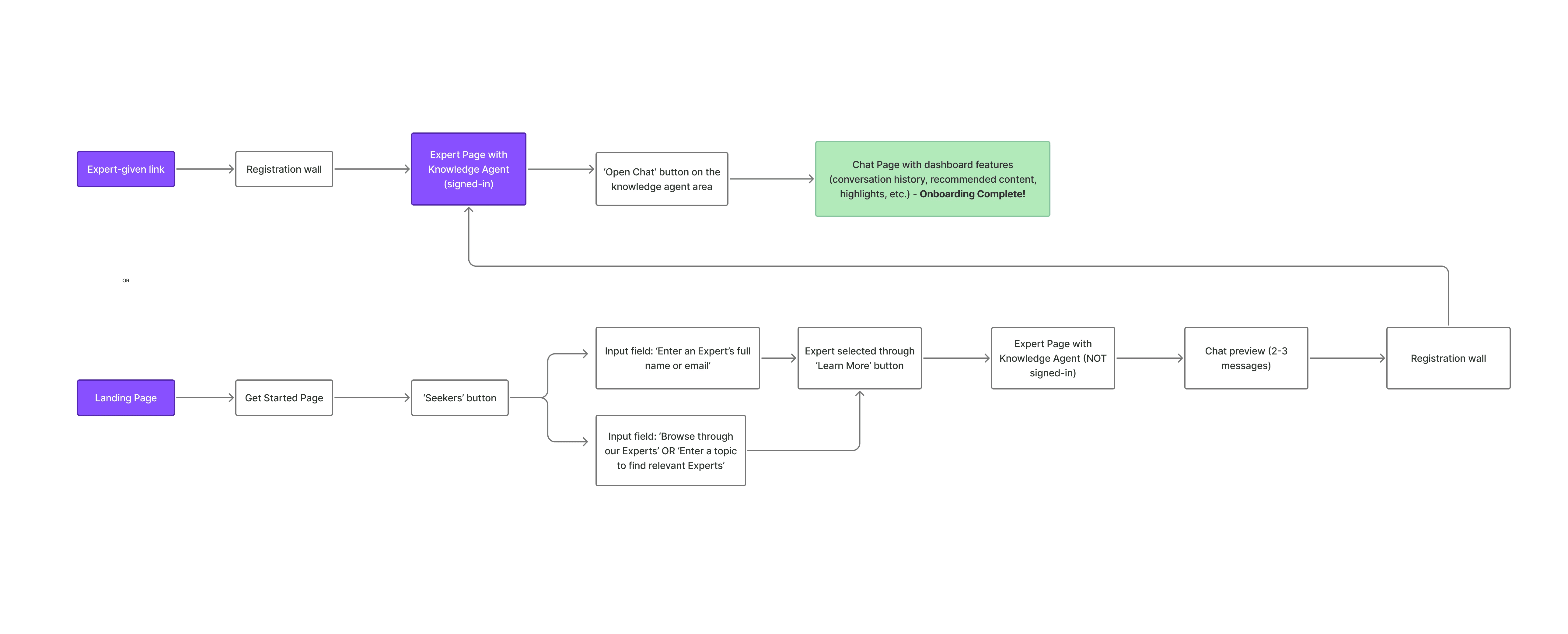
Based on these findings, I mapped out a new flow that prioritized early value demonstration of the Knowledge Agent, reduced clicks, and a way to discover relevant experts based on the Seeker's goals and interests.
Based on these findings, I mapped out a new flow that prioritized early value demonstration of the Knowledge Agent, reduced clicks, and a way to discover relevant experts based on the Seeker's goals and interests.
DESIGN SYSTEM
Material Design
For the designs, I was instructed to use Google's M3 Material Design System. This meant working within an established component library and design language, balancing creative problem-solving with system constraints to ensure consistency and scalability.
FINAL DESIGNS
Streamlined Expert Discovery
Seekers can enter a topic they want to learn about or generate a random one, then get matched with relevant experts.
Seekers can enter a topic they want to learn about or generate a random one, then get matched with relevant experts.

Proving Value Upfront
Users can experience the Knowledge Agent's capabilities before signing up, building confidence through real interactions.
Users can experience the Knowledge Agent's capabilities before signing up, building confidence through real interactions.

Consolidated Chat Features
Instead of fragmenting features across separate screens, Seekers can now access conversation history, recommended content, highlights, and call booking from a single view, reducing cognitive load and navigation friction.
Instead of fragmenting features across separate screens, Seekers can now access conversation history, recommended content, highlights, and call booking from a single view, reducing cognitive load and navigation friction.

REFLECTION
REFLECTION
Future Work
Future Work
Given more time and access to users, I would validate this redesign through usability testing on real Seekers and gather qualitative data for refinement. I would also love to track metrics such as sign-up conversion rates, time to first question asked, seeker retention, and drop-off points in the new flow to validate whether the redesign achieved its goals and reveal further opportunities for iteration.
Given more time and access to users, I would validate this redesign through usability testing on real Seekers and gather qualitative data for refinement. I would also love to track metrics such as sign-up conversion rates, time to first question asked, seeker retention, and drop-off points in the new flow to validate whether the redesign achieved its goals and reveal further opportunities for iteration.
OTHER WORK
OTHER WORK
Marketing Website
Marketing Website
Beyond the Seeker onboarding work, I collaborated with the Lead Designers on the marketing website's redesign. I contributed to ideation around homepage structure, messaging hierarchy, and visual storytelling approaches. Rapid brainstorming sessions with the team taught me how to hook new users while staying true to the product's core value.
Beyond the Seeker onboarding work, I collaborated with the Lead Designers on the marketing website's redesign. I contributed to ideation around homepage structure, messaging hierarchy, and visual storytelling approaches. Rapid brainstorming sessions with the team taught me how to hook new users while staying true to the product's core value.
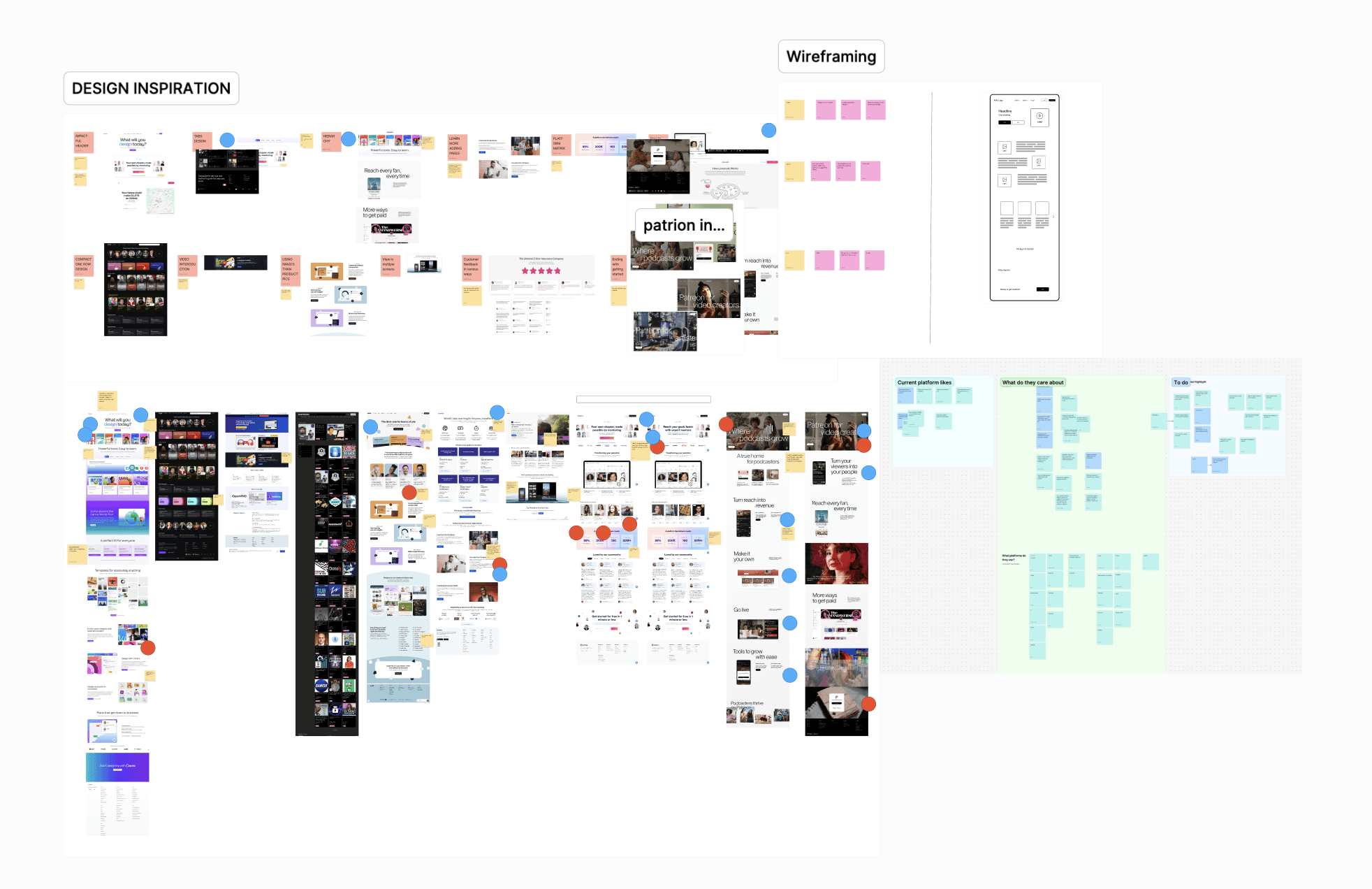
A Snapshot of Brainstorming Activities
A Snapshot of Brainstorming Activities